


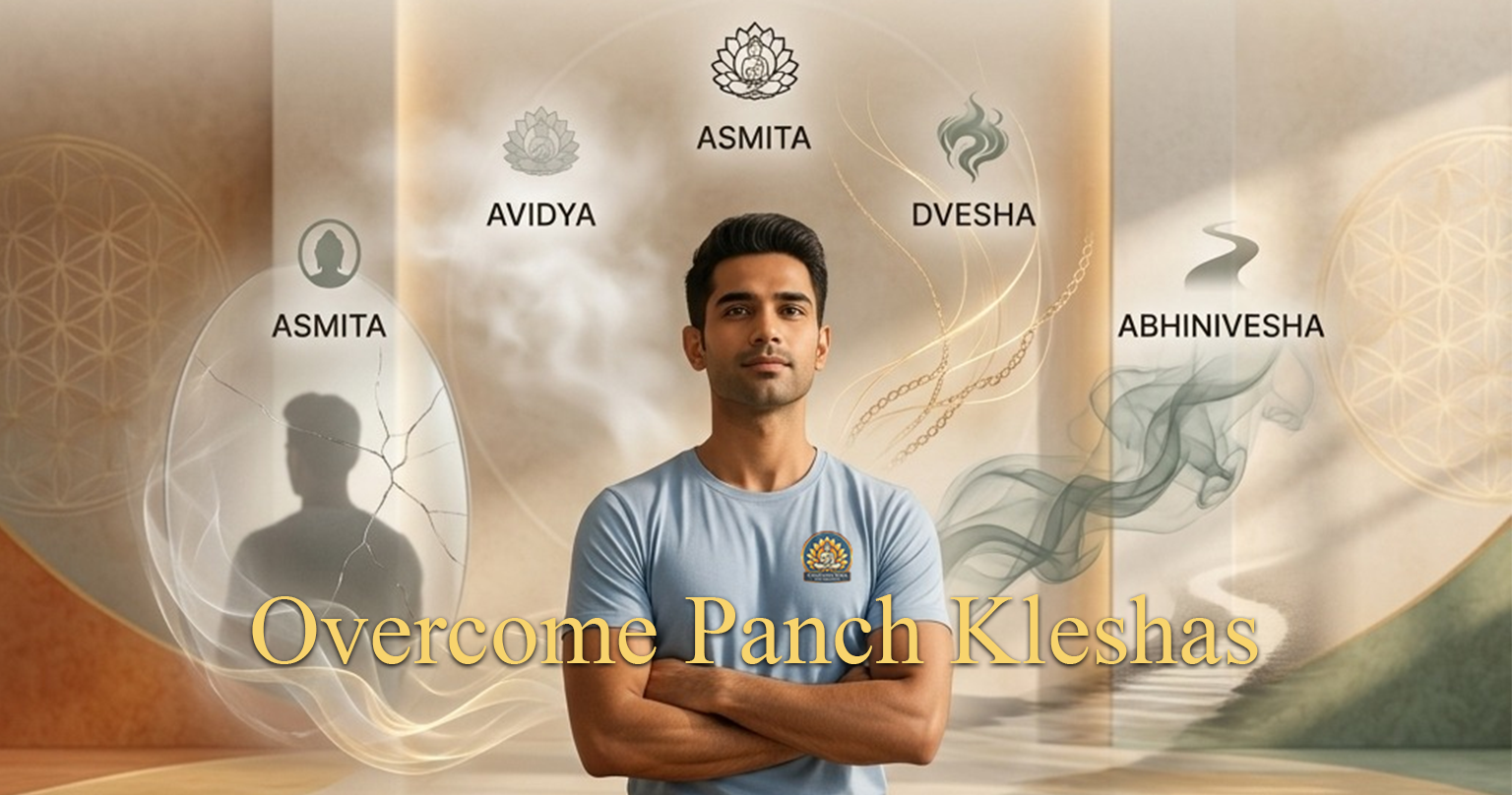
The Panch Kleshas in yoga or yogic philosophy are the five mental and emotional obstacles that create suffering, confusion, stress, and imbalance in human life. The concept is explained in the Yoga Sutras of Patanjali and is considered one of the core teachings of classical yoga.
The word “Klesha” means “disturbance,” “poison,” “affliction,” or “mental obstacle.” These kleshas disturb the mind and prevent us from experiencing peace, clarity, and spiritual growth.
The five Panch Kleshas are the following:
- Avidya – Ignorance or misunderstanding of reality
- Asmita – Ego or false identity
- Raga – Attachment or excessive desire
- Dvesha – Aversion or hatred
- Abhinivesha – Fear of loss, change, or death
Avidya (Ignorance)
Meaning
Avidya is the root of all suffering. It means not seeing life clearly and mistaking temporary things as permanent.
People often believe:
- Happiness comes only from money or status
- External validation defines self-worth
- Physical appearance is permanent
Impact on Life and How to overcome
| Daily Life Impact | How to Overcome Avidya |
| Constant dissatisfaction | Practice self-awareness and meditation |
| Wrong decisions | Read spiritual or yogic texts |
| Emotional confusion | Spend time in introspection |
| Stress due to unrealistic expectations | Practice mindfulness daily |
Myth vs. Truth
| Myth | Truth |
| “Success guarantees happiness.” | Inner peace matters more than external success. |
| “I am only my job/title/body.” | Your true self is beyond labels. |
Asmita (Ego)
Meaning
Asmita means identifying too strongly with the ego — “I,” “me,” and “mine.”
It creates separation and comparison.
Impact on Life and How to overcome
| Daily Life Impact | How to Overcome Asmita |
| Relationship conflicts | Practice humility |
| Need for constant appreciation | Observe reactions without judgment |
| Insecurity and comparison | Practice seva (selfless service) |
| Difficulty accepting criticism | Reduce comparison with others |
Myth vs. Truth
| Myth | Truth |
| “Strong ego means confidence.” | True confidence comes from inner stability. |
| “I must always be right.” | Growth happens through openness and learning. |
Raga (Attachment)
Meaning
Raga is excessive attachment to pleasure, comfort, people, or outcomes.
Attachment creates dependency.
Impact on Life and How to overcome
| Daily Life Impact | How to Overcome Raga |
| Emotional dependency | Practice gratitude |
| Anxiety when expectations fail | Learn detachment without avoiding responsibilities |
| Addiction to comfort or validation | Reduce over-dependence on external happiness |
| Fear of losing relationships or possessions | Practice meditation and mindful living |
Myth vs. Truth
| Myth | Truth |
| “Attachment is love.” | True love allows freedom and balance. |
| “More possessions bring more peace.” | Inner contentment creates peace. |
Dvesha (Aversion)
Meaning
Dvesha is dislike, hatred, or avoidance toward unpleasant experiences, people, or memories.
It develops from painful experiences.
Impact on Life and How to overcome
| Daily Life Impact | How to Overcome Dvesha |
| Anger and irritation | Practice forgiveness |
| Emotional triggers | Observe emotional triggers consciously |
| Holding grudges | Use breathwork and meditation |
| Negative thinking patterns | Develop compassion and empathy |
Myth vs. Truth
| Myth | Truth |
| “Avoiding pain solves problems.” | Healing comes through awareness and acceptance. |
| “Hatred protects me.” | It harms inner peace first. |
Abhinivesha (Fear of Loss or Death)
Meaning
Abhinivesha is deep fear — fear of change, uncertainty, failure, aging, or death.
Even wise people experience this fear.
Impact on Life and How to overcome
| Daily Life Impact | How to Overcome Abhinivesha |
| Anxiety and over thinking | Practice acceptance |
| Fear of taking risks | Build trust in life’s process |
| Clinging to comfort zones | Practice Pranayam and meditation |
| Stress about the future | Stay present instead of over thinking the future |
Myth vs. Truth
| Myth | Truth |
| “Fear keeps me safe all the time.” | Excess fear limits growth and peace. |
| “Change is dangerous.” | Change is a natural part of life. |
How Yoga Helps Reduce Panch Kleshas
Yoga is not only physical exercise — it is a complete system for mental clarity and emotional balance.
| Practices that help: | Over time, yoga helps develop: |
| Meditation | Awareness |
| Pranayama | Emotional balance |
| Self-reflection | Inner peace |
| Mindfulness | Detachment |
| Yogic lifestyle | Self-understanding |
| Ethical living (Yamas & Niyamas) |
Conclusion
The Panch Kleshas explain why humans experience stress, suffering, emotional instability, and confusion. Understanding these five obstacles helps us become more aware of our thoughts, emotions, and behavior.
By practicing yoga, meditation, self-awareness, and mindful living, we can gradually reduce the influence of:
- Avidya (ignorance)
- Asmita (ego)
- Raga (attachment)
- Dvesha (aversion)
- Abhinivesha (fear)
The journey of yoga is not about becoming perfect — it is about becoming conscious.
The upcoming blog will be on all myths and truths about “Yoga” and their “Trends”
Leave a Reply